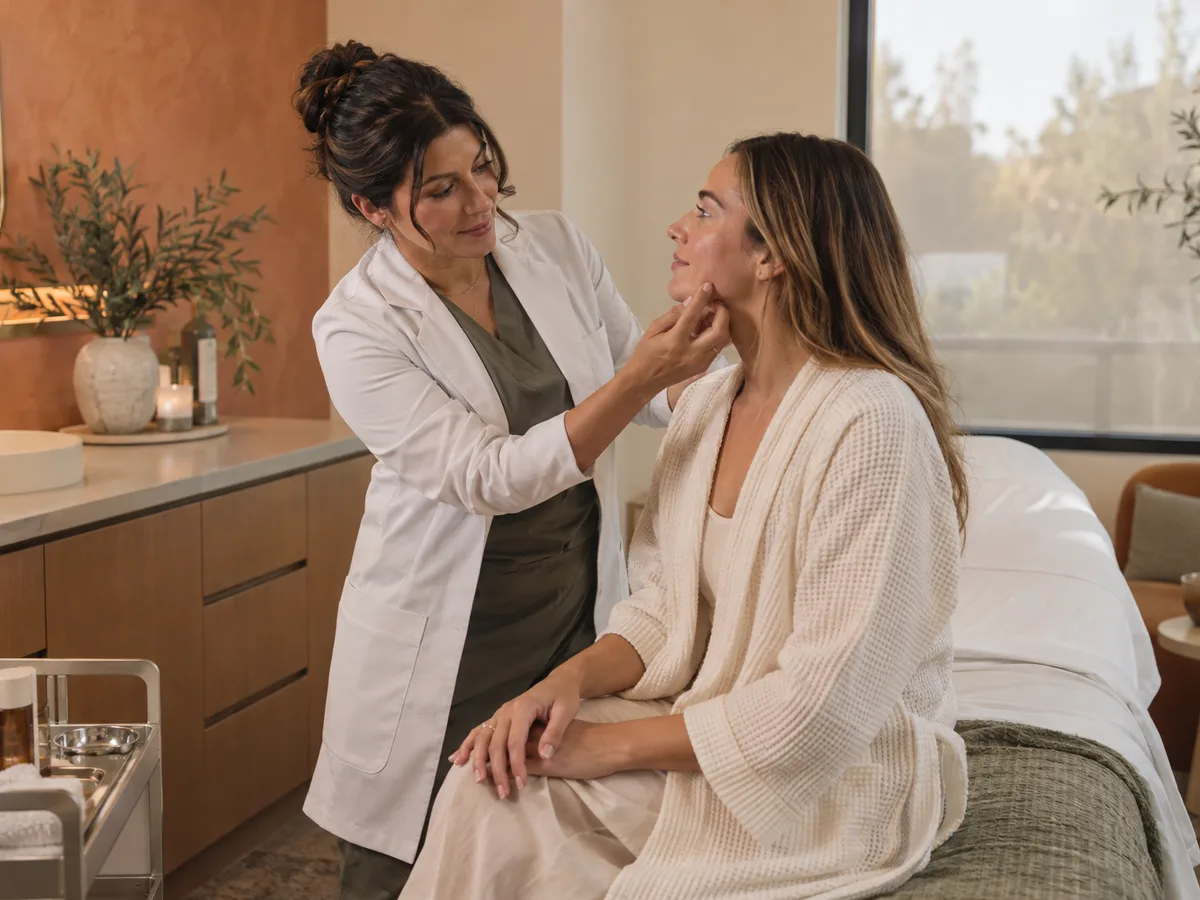
Our article on skin boosters versus topical serums covers what a serum can and cannot do, but as a priming layer it earns its place.
Reconsider new products
The weeks before an appointment are not the time to try a new active or a new brand. A reaction that appears at day ten pushes the appointment back or, worse, is not noticed until the injector is looking at an irritated forehead.
Two to three weeks out
Sun
Sun is the single biggest priming variable in Los Angeles. A sunburned forehead cannot be treated, and a tanned one is harder to assess for redness and bruising afterward.
The Weather Service's Los Angeles forecast office publishes ultraviolet index readings, and they are high across most of the year here.
Daily sunscreen on the forehead, a hat outdoors, and a deliberate reduction in midday exposure in the two weeks before an appointment make a visible difference to how the skin heals.
Other procedures
Facials, peels, microneedling and laser treatments on the forehead should be finished and healed well before an injectable appointment, or scheduled after it with a gap.
Stacking treatments on the same area within a short window multiplies the swelling and complicates any assessment of what caused what. Injectors will ask; be ready with dates.
Dental work
Less obvious but relevant for fillers: dental procedures raise the level of bacteria in the bloodstream for a short period, and some injectors prefer a gap between dental work and filler placement to reduce the chance of a delayed reaction.
Temple filler is deep and this matters more than for superficial work. Ask.
The week before
Blood-thinning substances
Bruising on the forehead is the most visible side effect and the most avoidable. Common over-the-counter pain relievers of the anti-inflammatory kind, fish oil, vitamin E, and several herbal supplements thin the blood. Alcohol does too.
Most injectors ask for these to be paused for a period ahead of the visit, with the caveat that anything a clinician has directed you to take is not paused without that clinician's agreement.
Readers on any regular medication should say so in the consultation, plainly, before the day.
Hydration and sleep
A dehydrated forehead reads as more lined and bruises more. Drink normally, sleep normally, and arrive without the residue of a late night.
This sounds like advice from a relative, and it is, but it is also what injectors say when asked what makes their job easier.
Illness
A cold sore, a skin infection anywhere near the treatment area, or a general illness is a reason to reschedule. Injectors would rather move an appointment than treat compromised skin. Say so; nobody minds.
The day
Arrive with a clean forehead and no makeup. Eat something first; a small number of people feel faint during injections and an empty stomach makes it worse. Bring the list of what you take and what you paused, with dates.
Plan nothing strenuous, no sauna and no long time in the sun for the rest of the day, and for temple filler in particular, plan a quiet evening.
Wear a shirt that does not pull over the head.
The days after
Priming does not stop at the door. For the first day or two, keep the forehead upright as much as you can, skip the gym, and avoid pressing on the treated area; that includes tight hats, headbands and face-down sleeping.
Resume the gentle routine the next morning. Hold the paused actives until the office says otherwise, which for boosters is usually a week or more and for neuromodulators is often a day or two.
The point of the preparation was calm skin; the point of the aftercare is to keep it that way while the visible healing passes.
What differs by treatment
In practical terms, the next point is how the three treatment families weight these steps.
Neuromodulators are the least demanding. Blood-thinner pause, calm skin, no sun. The needle passes through the skin and deposits product in muscle, so the skin's condition matters mostly for bruising.
Fillers, especially temple and brow bone, add the dental gap and a stronger emphasis on avoiding illness, because the product sits deep for months and any delayed reaction is more consequential.
Bruising at the temple can be dramatic and slow, so the blood-thinner pause matters more.
Skin boosters are the most demanding of the skin itself, because the product is placed in the dermis across a wide area.
Active pause, sun discipline and a well-hydrated barrier all directly change how evenly the product settles and how quickly the many small injection points heal.
Questions to settle before you book
Which office, and what do they ask for? Priming instructions vary, and a good office sends them in writing well ahead of the visit. If they do not, ask.
What do you take, and what can you pause? Make the list now, not in the waiting room.
What is on your calendar for the two weeks after? Bruising and swelling on the forehead are visible above any collar and under most makeup for several days. Events, photographs and travel belong outside that window.
How much sun will you take between now and then? Answer honestly, and if the answer is a lot, either change it or move the appointment.
Here in Los Angeles
Los Angeles readers face two local wrinkles. The first is the sun, covered above. The second is fire season.
Smoke days raise skin irritation across the city, and several readers have described appointments that went less well than expected during heavy smoke.
The LAFD posts current incident and air quality information, and it is worth a glance when choosing a date in the late summer and autumn.
Readers who want to check that a medical spa holds the city permits it should can start with the city's business portal.
For readers who prefer to read the underlying skin science before an appointment, UCLA's own overview points toward its dermatology and health resources.
What readers tell us afterward
The readers who write back after following a preparation window describe the same two things. Bruising was lighter than on earlier visits, and the injector remarked on how calm the skin was before the first needle.
The readers who skipped it describe the opposite, usually with a photograph they wish they had not needed to take. Neither group is a study, and we do not present them as one.
They are the pattern in our inbox, and the pattern is consistent enough to pass along.
Conclusion
Priming is the unglamorous part of a brow or forehead injectable plan, and it is the part most within your control.
Calm, hydrated, unburned skin with a paused list of blood thinners and no recent stacked procedures gives the injector a forgiving surface and gives you a result that reads cleanly sooner.
Start four to six weeks out, keep the gentle routine, respect the sun, and arrive with your lists written down. The appointment is fifteen minutes. The preparation is what decides how those fifteen minutes look a week later.