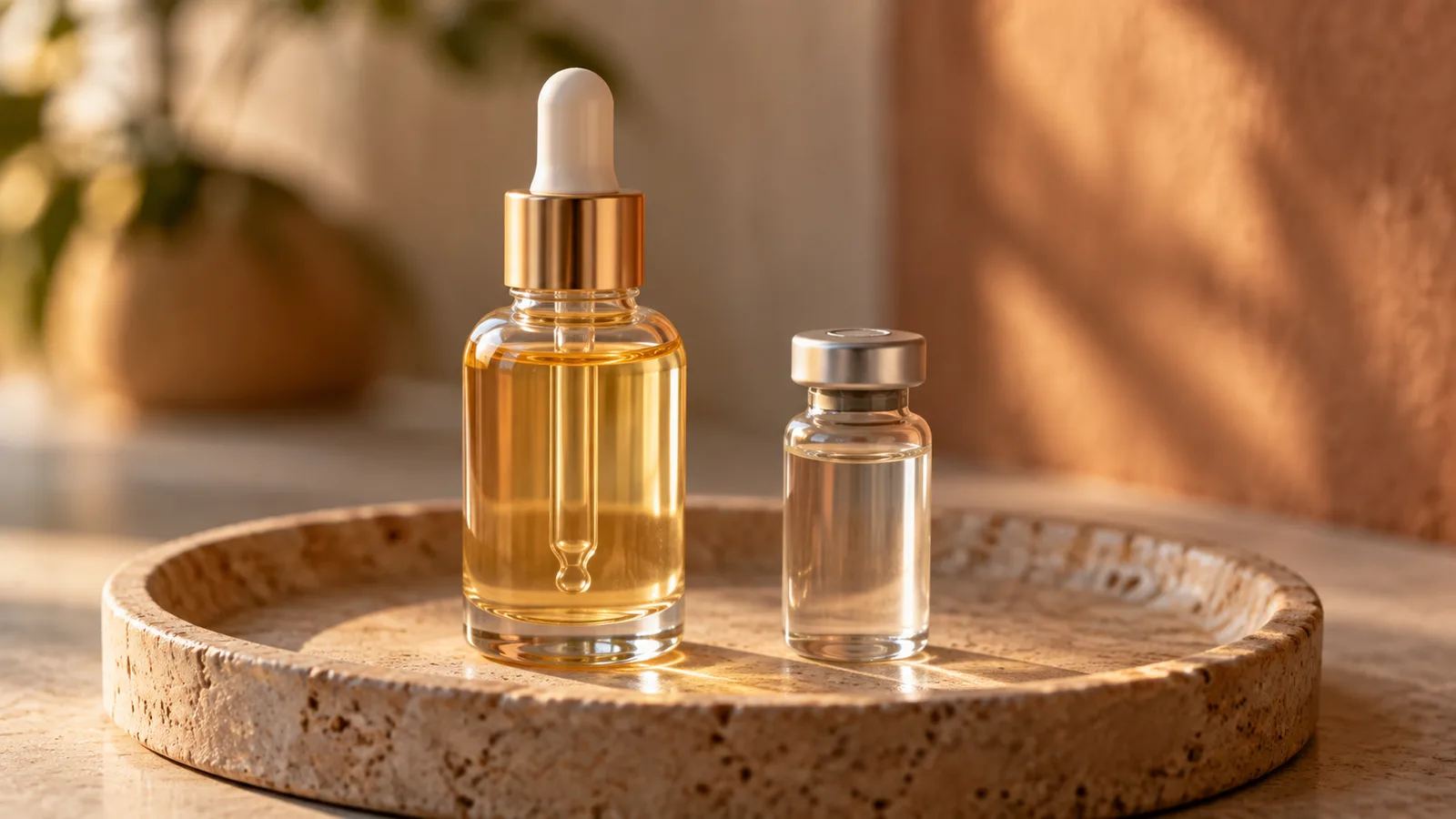
What a skin booster reaches
A skin booster is a soft, lightly cross-linked or uncrosslinked hyaluronic acid gel. It is not a filler in the usual sense; it is not designed to lift or shape.
Instead the injector places it superficially, into the dermis itself, as a grid of tiny deposits across the treatment area. Some techniques use a fine needle, others a cannula, others a multi-needle device.
Once in the dermis, the hyaluronic acid does what it does everywhere in the body: it binds water. The dermis becomes more hydrated from the inside.
Over a series of sessions, the skin tends to feel more supple under the fingertips and reflect light more evenly. Some products are also formulated to encourage fibroblasts, the cells that make collagen, to become more active.
Where boosters do their best work
Boosters are used on the forehead for the fine crepey texture that neuromodulators leave behind. A neuromodulator stops the muscle folding the skin, but if the skin has already thinned, the fold marks remain as etched lines even at rest.
A booster addresses the skin quality itself. It is also used across the temples and the brow area to improve the way skin drapes over bone, though that use is more injector-dependent.
Readers often notice the change as touch first and appearance second. The forehead feels less papery. Makeup sits differently.
Photographs catch up a few weeks later.
Where they fall short
Boosters do not stop movement, so they do nothing for dynamic lines made by the frontalis or the frown muscles. They do not lift a brow. They do not add volume to a hollow temple in the way a structural filler does.
And they require a series: a single session tends to produce a modest, temporary change, and most protocols assume two or three sessions spaced weeks apart before the effect is judged.
Comparing the two honestly
When comparing options, the choice often turns on which layer holds the problem. That sounds obvious written down. In practice, readers rarely know which layer their forehead lines live in, and product marketing is written to blur it.
Depth
A serum reaches the surface and, slowly, the top of the living epidermis. A booster is placed in the dermis directly.
If the line you dislike disappears when you gently stretch the skin flat with two fingers, it is more likely to be a surface or movement line. If it stays as a fine etched mark under stretch, it is more likely to be dermal.
Duration
A serum's effect lasts as long as you keep applying it, with hydration fading within a day or two of stopping.
A booster series is generally described by product labeling as holding for several months before a maintenance session, though the range readers report is wide and depends on the product, the number of sessions, and how much sun the forehead takes.
Cost
Here the comparison misleads people most. A serum costs a fraction of a booster session, and readers often frame the choice as cheap versus expensive. But a serum is bought continuously, forever, and does one job.
A booster series is bought in a block and does a different job. The honest comparison is not price against price but problem against problem.
If your problem is dermal, no quantity of serum solves it and the serum money is spent on comfort rather than change. If your problem is surface hydration, a booster is a large spend on a problem a topical handles.
Risk
Topicals carry the risk of irritation, especially retinoids and acids on sun-exposed skin. Boosters carry the risks of any injectable: bruising, swelling, small lumps that resolve or need attention, and the rarer vascular complications that make injector training matter.
Both categories carry risk, and the risks are different in kind, not simply in degree.
The forehead and brow specifically
The forehead has three features that shape this decision. It is a large flat plane, so texture changes are visible from across a room. It is in constant motion, so any dermal work has to coexist with the frontalis.
And it takes more sun than nearly any other part of the body.
That last point matters in Los Angeles more than in most cities. Forehead skin here spends years under direct ultraviolet exposure through a windshield and on sidewalks.
Local forecasts from the Weather Service's LA office include ultraviolet index readings that are high through much of the year. Any booster plan for the forehead, and any serum routine, starts with sun protection as the non-negotiable base layer.
Without it, both are pouring water into a leaking bucket.
The brow complicates things further. Volume loss at the temple makes the brow tail look heavy, and neither a serum nor a booster fixes that; it is a structural filler question, covered in our article on facial balancing around the brow.
Readers who come to a booster hoping it will lift the brow are usually disappointed, and readers who come to a structural filler hoping it will fix crepey texture are disappointed the other way.
A sequence that tends to work
With that context, the better question is not which product but which order. The sequence injectors most often describe to us runs like this.
Start with sun protection and a simple serum routine. This is the floor, not the ceiling, and it costs little. Give it two or three months while you decide anything else.
If movement lines dominate, consider a neuromodulator next. It stops the folding and, over time, lets shallow etched lines soften on their own as the skin stops being creased hundreds of times a day.
If etched or crepey texture remains at rest after that, a booster series is the next step. Many injectors prefer to place boosters after the neuromodulator has settled, so the skin is at rest during the healing weeks.
Keep the serum going throughout. It is the maintenance layer for everything above it.
What to settle before you book anything
Three questions are worth answering before a consultation, because they determine which conversation you are about to have.
Does the line vanish under gentle stretch? If so, ask about movement first.
Does the skin feel papery and tight, or does it feel fine and simply look lined? Papery points toward hydration, topical first, dermal second. Fine-feeling but lined points toward movement or structure.
How much sun does your forehead take in a normal week, and are you willing to change that? If the answer is a lot and no, boosters will underperform and the injector should tell you so.
Here in Los Angeles
Los Angeles is a city where a booster series can be found at very different price points a few blocks apart, and where technique varies as much as price.
Readers who travel for treatment, or time a series around trips through the city's airports, should plan the healing window into the calendar rather than around it; swelling on the forehead is visible and does not care about flights.
The City of Los Angeles publishes the rules under which businesses in the city operate in its charter and municipal codes, a useful starting point for readers who want to check how a medical spa is permitted.
USC's public news pages occasionally cover skin research in plain language, for readers who want background beyond what we can offer here.
Conclusion
A serum and a skin booster are answers to two different questions, and the first task is to work out which question your forehead is asking. Surface dehydration and tone are topical problems.
Etched, crepey texture at rest is a dermal problem and belongs to the booster. Movement lines belong to neither.
Readers who have narrowed it down that far can read how one Los Angeles practice describes its own treatments, with this article beside it, then take the questions above into the consultation.
The injector who answers them plainly is the one worth listening to.