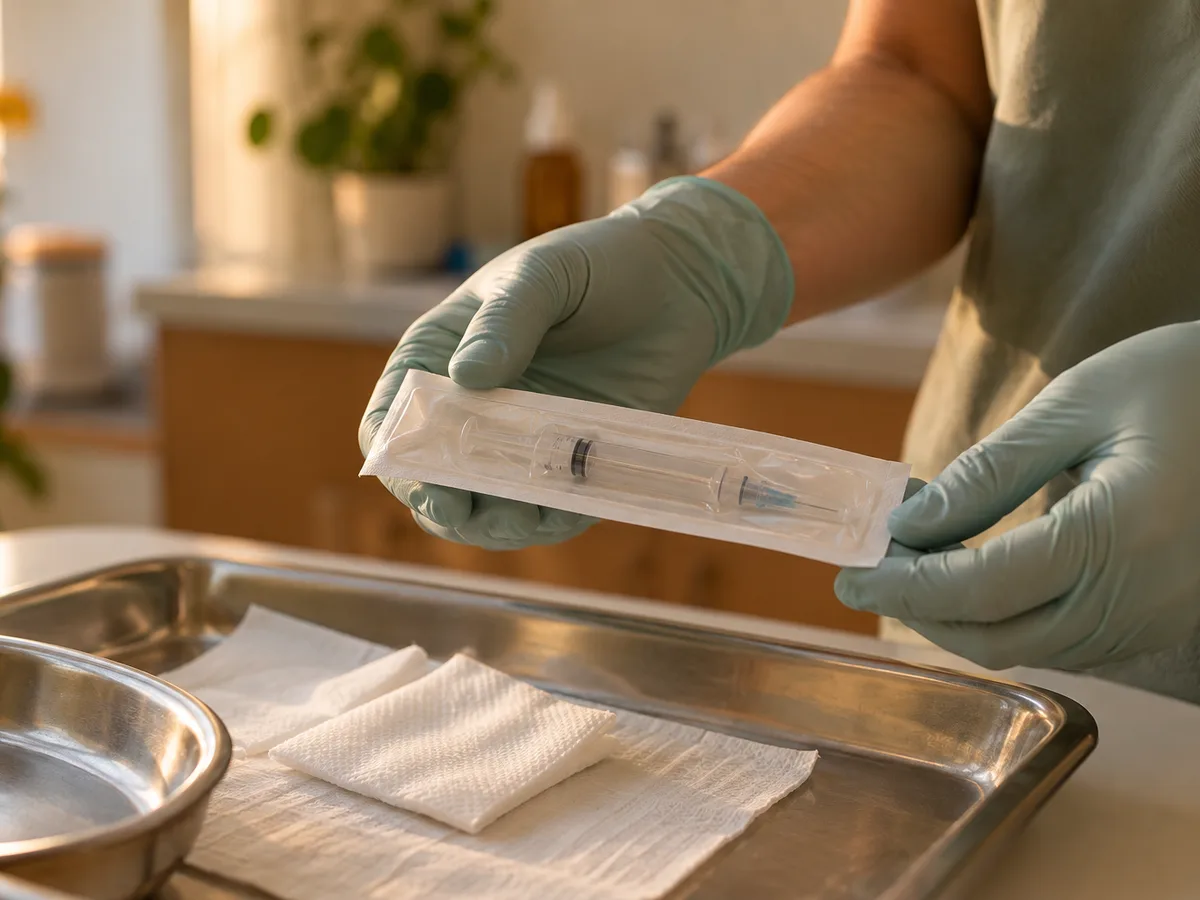
How subcision works
Subcision is the step readers have most often never heard of, and it is frequently the step that matters most.
A needle or a small blunt instrument is passed under the scar, parallel to the surface, and swept back and forth to cut the fibrous strands tethering it down. Released from below, the scar lifts.
The body then fills the small space created under the released scar with blood and, over weeks, with new collagen. Some injectors rely on that alone.
Most place a filler into the space at the same time, for two reasons: it holds the released skin up while healing happens, and it stops the strands from reattaching in the same place.
Subcision without filler tends to give a partial lift that fades as the space closes. Filler without subcision tends to push a tethered scar up temporarily while the strands pull it straight back down. The pairing is what makes the result hold.
How filler lifts a scar
Once the scar is released, filler is placed beneath it in a small volume, just enough to bring the floor of the depression level with the surrounding skin. The goal is level, not raised.
An over-filled scar reads as a bump and is more visible than the dip was.
Product choice
Hyaluronic acid fillers are the usual starting point. They are soft, reversible with an enzyme if the result needs adjusting, and available in a range of thicknesses. Softer products go under thin rolling scars; slightly firmer products go under wider boxcars that need more support.
Biostimulator products, which prompt the body to make its own collagen over months rather than adding volume directly, are used by some injectors for broad fields of rolling scars where the goal is to thicken the whole area.
They are not reversible, and results emerge slowly, so they suit readers who prefer a gradual change and have the patience for it. We compare the two categories in more detail in Dermal Fillers for Acne Scars.
Technique
Scar filler is placed in tiny amounts, often a fraction of what would be used to shape a cheek. Injectors may use a fine needle to deposit small droplets directly under each scar, or a cannula to fan product under a cluster.
The skin over a scar is unforgiving; product that is too superficial shows as a pale or bluish spot, and product that is too deep does not lift the floor.
This is precise work, and the injector's experience with scars specifically, rather than with fillers in general, is worth asking about.
What a good result looks like
When comparing options, the choice often turns on what you are willing to call success.
A good filler result for a depressed scar is a scar that is level, no longer casts a shadow, and reads as a change in color or texture rather than a hole. The edges may still be visible. The scar tissue is still there.
Under a fingertip you may still feel a slight difference in texture.
What changes is how the face reads from a normal distance and in ordinary light. Shadows are what the eye catches; remove the depth and the eye moves on.
Readers sometimes describe the change as the scar becoming a mark instead of a feature. That is about the right expectation.
Limits and disappointments
Filler does not treat ice pick scars. It does not change the color of a scar. It does not smooth the surface texture of the scar tissue itself, which is a resurfacing job.
It does not last forever; hyaluronic acid under a scar is metabolized over months, though many readers report that scars stay improved longer than the product would suggest, presumably because the subcision and the collagen response do lasting work.
Bruising after subcision is common and can be dramatic for a week or two. Swelling can make scars look worse before they look better.
A single session is rarely the whole plan; most injectors describe two or three rounds of subcision and filler spaced weeks to months apart, with the field reassessed each time.
And there is the volume-around-the-scar problem from earlier. If a scar has become prominent because the whole cheek has lost support, filling the scar alone may not be the right first step.
Restoring the cheek can shallow every scar on it at once, and injectors will sometimes propose that before any scar-specific work. It is a larger conversation and a larger budget, and it is worth having before committing to a scar-by-scar plan.
Timing
Fresh scars are not filled. A scar keeps remodeling for months after the wound closes, changing in depth, color and texture as the collagen matures.
Filling it early means treating a target that is still moving, and it can interfere with the natural flattening that many scars manage on their own.
Injectors commonly wait until the scar has been stable for a period they judge sufficient, which for most acne and surgical scars is measured in many months. Our article on scar treatment timing covers the windows in detail.
Active acne is a separate timing issue. Injecting filler into a field of scars while new lesions are still forming means new scars arrive after the plan is done, and the inflammation can complicate healing. Most injectors want acne controlled first.
Questions to settle before a consultation
Do your scars flatten when you stretch the skin? If yes, they are likely rolling scars and the subcision-and-filler approach is in play. If they stay, they are more likely boxcar or ice pick and the conversation is different.
Is your acne currently active? If yes, expect to be asked to address that first.
Has your face lost volume generally? If the scars seem to have appeared or worsened in the last decade without new acne, the answer may be yes, and the injector may talk about the cheek before the scars.
What are you willing to call success? Level and shadowless is achievable for many rolling scars. Invisible is not.
Here in Los Angeles
Scar work is staged over months and involves visible bruising, so Los Angeles readers tend to plan it around the calendar.
Cooler months take the heavier sessions, because sun exposure on a healing field is hard to manage in a Los Angeles summer, and the warm season takes lighter maintenance.
ABC7's local newscasts regularly report heat and ultraviolet advisories that are worth folding into that plan.
Readers who want to look into how medical practices are regulated in the city can start with how the city government is organized.
Those who want to read past our summaries will find the Los Angeles Public Library in the city directory.
Conclusion
A depressed scar sits low for a reason, usually tethering, sometimes lost volume, often both. Filler lifts it by putting material back underneath; subcision makes that lift hold by cutting what was pulling it down.
Together they turn a shadow into a mark for the scar types that respond, and they do little for the types that do not.
Work out which shape your scars are, whether your acne is quiet, and whether the whole cheek has changed, then take those three answers into the consultation.
An injector who sorts your scars by shape before naming a product is one who has done this before.